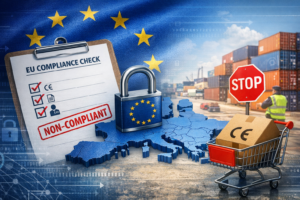
Many manufacturers assume that once their products are CE-certified, they can be freely sold across the European Union without further structural requirements. In reality, this assumption is one of the most critical compliance mistakes, because EU law requires a clearly defined economic operator within the EU who can be contacted by authorities at any time. If no EU Authorised Representative is appointed, or if the role is not properly implemented, the product may be considered non-compliant regardless of its technical certification. This creates a situation in which products that are fully functional and tested can still be stopped at the border, removed from the market, or subject to enforcement actions simply because the legal structure behind them is incomplete.
Legal Reality: Certification Is Not Enough
While many manufacturers rely on CE marking as proof that their products meet all necessary EU requirements, this assumption overlooks a fundamental aspect of the regulatory framework. Certification confirms that a product has been tested against applicable standards, but it does not establish a legally accountable presence within the European Union. Authorities do not only assess whether a product is technically compliant, but also whether there is a clearly defined structure that allows them to request documentation, enforce obligations, and communicate with a responsible entity inside the EU. Without such a structure, even fully certified products may be considered non-compliant in practice, because enforcement cannot be carried out effectively.
CE marking confirms:
- technical conformity
- compliance with product directives
But it does NOT ensure:
- legal presence in the EU
- accessibility for authorities
- defined responsibility
👉 Without an EU Authorised Representative, a critical part of compliance is missing.
Immediate Consequences
Once products are placed on the EU market without a properly defined EU Authorised Representative, the consequences typically do not appear gradually but occur as immediate reactions from authorities or market actors. In many cases, manufacturers only become aware of the issue when their products are already in distribution and a compliance gap is identified. At that point, the situation shifts from a theoretical risk to a real operational problem, where time pressure, documentation gaps, and unclear responsibilities start to create friction. Authorities and platforms are not required to wait for clarification and may act quickly to limit further distribution until the situation is resolved, which can interrupt ongoing sales and affect multiple channels simultaneously.
Selling without an EU Authorised Representative can trigger:
- product stops at customs
- requests from market surveillance authorities
- removal from online marketplaces
- forced documentation submission
These actions can happen without prior warning.
Customs Stops: The First Barrier
Customs authorities are often the first point at which compliance issues become visible, especially for products entering the European Union from non-EU countries. At this stage, checks are not limited to physical inspection or safety concerns, but also include verification of documentation, traceability, and the presence of a responsible economic operator within the EU. If the required information is missing or unclear, the shipment may be flagged for further review, even if the product itself appears technically compliant. This creates a situation where goods that are ready for distribution are effectively blocked before they can reach the market, simply because the legal structure behind them is incomplete or cannot be verified in time.
One of the most common real-world consequences is:
👉 customs intervention
Products may be:
- held
- inspected
- blocked
If required information is missing:
- release may be delayed
- or denied completely
Market Surveillance Actions
Once products are available on the EU market, responsibility shifts from border control to market surveillance authorities, whose role is to verify ongoing compliance and enforce regulatory requirements. These authorities actively monitor products in circulation, including those sold through distributors and online platforms, and may initiate checks based on routine inspections, complaints, or irregularities in documentation. In such cases, the focus is not only on the product itself, but on whether a clearly defined and reachable compliance structure exists within the EU. If no EU Authorised Representative is appointed, or if the role is not properly implemented, authorities may face difficulties identifying a responsible contact, which typically leads to escalation and stricter scrutiny of the entire setup.
Authorities can:
- request full documentation
- demand clarification of responsible entities
- impose deadlines
- escalate cases
👉 If no EU AR is defined: There is no clear contact point
Product Bans and Withdrawals
When compliance issues cannot be resolved in a timely and verifiable manner, authorities may move beyond requests and initiate formal measures to restrict or stop the distribution of products on the EU market. At this stage, the focus is no longer on clarification but on risk mitigation, meaning that products may be treated as non-compliant until proven otherwise. This can happen even if the underlying issue is not related to product safety, but to missing documentation, unclear responsibility, or the absence of a properly appointed EU Authorised Representative. Once such measures are initiated, they can affect not only individual shipments but entire product lines and distribution channels, creating immediate disruption for manufacturers and their partners.
If compliance cannot be demonstrated:
- products may be banned
- sales may be stopped
- listings may be removed
👉 This applies across:
- online platforms
- distributors
- physical retail
Chain Reaction Risk
Once a compliance issue is identified, it rarely remains limited to a single product or shipment. In practice, authorities tend to expand their review to determine whether the problem is isolated or part of a broader structural deficiency. This means that a missing EU Authorised Representative, incomplete documentation, or unclear responsibility in one case can quickly trigger a wider investigation across the entire product portfolio. The situation is further amplified when multiple distributors or importers are involved, as inconsistencies between documentation, labelling, or communication processes become more visible and raise additional concerns. What initially appears as a minor issue can therefore escalate into a systematic review of multiple products, sales channels, and business partners.
A single issue can affect:
- multiple products
- entire product lines
- all distributors
👉 Authorities often expand investigations once a problem is identified.
Financial Impact
The financial consequences of compliance failures are often underestimated, as the initial issue may appear limited to documentation or procedural gaps. In reality, once enforcement actions begin, costs arise quickly and across multiple areas of the business. Delays at customs, interruptions in distribution, and the need for corrective measures create immediate operational expenses, while lost sales and contractual disruptions can have longer-term financial effects. These impacts are rarely isolated and tend to accumulate, especially when multiple products or markets are affected simultaneously. What starts as a relatively small compliance gap can therefore evolve into a significant financial burden that extends well beyond the original issue.
Costs can arise from:
- logistics delays
- storage fees
- relabelling
- legal handling
- lost sales
👉 These costs often exceed compliance setup costs significantly.
Reputational Risk
Beyond immediate operational and financial consequences, compliance failures can have a lasting impact on how a manufacturer is perceived in the market. Distributors, platforms, and business partners rely on the assumption that products are not only technically compliant but also supported by a reliable and well-structured regulatory framework. When issues arise, especially those that lead to product removals, delays, or authority involvement, confidence in the manufacturer can quickly erode. This loss of trust is often difficult to reverse, as partners may become more cautious, impose stricter requirements, or reconsider future cooperation. In highly competitive markets, even a single compliance incident can influence long-term relationships and limit access to distribution channels.
Non-compliance may lead to:
- loss of distributor trust
- platform restrictions
- long-term market access issues
Why This Happens So Often
Despite clear regulatory requirements, compliance gaps related to the EU Authorised Representative occur frequently because the underlying obligations are often misunderstood or underestimated during market entry. Many manufacturers focus primarily on technical certification and product readiness, assuming that once testing and CE marking are completed, the product is fully compliant for sale within the European Union. However, the legal and organisational aspects of compliance require a different level of attention, particularly when it comes to defining responsibilities, ensuring documentation accessibility, and establishing a reliable point of contact within the EU. In practice, these elements are either addressed too late or handled superficially, resulting in structures that appear compliant on paper but fail under real-world conditions.
Common reasons:
- misunderstanding of EU law
- assumption that importer is sufficient
- missing compliance structure
- purely formal setup
Special Risk: Online Sales
Selling products through online channels introduces an additional layer of exposure, as digital marketplaces significantly increase transparency and traceability for authorities. Unlike traditional distribution models, where products move through defined supply chains, online sales make it easier to identify manufacturers, product listings, and compliance gaps in real time. Authorities can access product information directly, monitor listings across multiple platforms, and initiate checks without relying on physical inspections alone. This means that missing or incomplete compliance structures, including the absence of a properly appointed EU Authorised Representative, can be detected much faster and with less effort. As a result, enforcement actions in the context of e-commerce tend to occur more quickly and with broader reach.
In e-commerce:
- products are directly visible to authorities
- traceability is easier
- enforcement is faster
👉 Missing EU AR is quickly detected.
Increasing Enforcement in 2026
Regulatory enforcement across the European Union has become significantly more active, driven by a combination of stricter legal frameworks, increased coordination between authorities, and the growing volume of products entering the market from non-EU countries. Market surveillance bodies are no longer limited to reactive checks but are increasingly using proactive monitoring methods, including digital tools and cross-border data exchange, to identify compliance gaps more efficiently. This shift means that manufacturers are more likely to be reviewed even without prior incidents, and deficiencies such as a missing or improperly implemented EU Authorised Representative are detected earlier in the product lifecycle. As enforcement becomes more systematic, the tolerance for incomplete or purely formal compliance setups continues to decrease.
Authorities are focusing on:
- non-EU manufacturers
- cross-border trade
- digital marketplaces
- documentation transparency
👉 Risk is increasing, not decreasing.
How to Avoid These Risks
Avoiding enforcement actions requires more than simply appointing an EU Authorised Representative in a formal sense; it depends on building a structured and operational compliance setup that can withstand real-world scrutiny. Manufacturers need to ensure that all elements of their EU market access are aligned, from clearly defined responsibilities to consistent documentation and a reliable communication framework. In practice, this means that compliance must be treated as an integrated process rather than a single step, with all involved parties understanding their roles and being able to respond quickly when required. A well-prepared structure not only reduces the likelihood of regulatory issues but also ensures that, if authorities initiate checks, the situation can be handled efficiently without escalation.
To avoid enforcement:
- appoint an EU Authorised Representative
- define clear responsibilities
- ensure documentation availability
- align labelling and information
Conclusion
Selling products in the European Union without a properly defined EU Authorised Representative is not a minor oversight but a structural compliance gap that can trigger immediate and far-reaching consequences. While many manufacturers focus on technical certification, the absence of a clear legal and organisational framework undermines the ability to demonstrate compliance when it is actually required. As regulatory enforcement becomes more proactive and interconnected, authorities expect not only compliant products but also a transparent and functional structure that allows for efficient communication and accountability. Without this, even well-prepared products can be treated as non-compliant in practice. Establishing a robust compliance setup is therefore not only a regulatory obligation but a necessary condition for maintaining stable and uninterrupted access to the EU market.
It is a structural compliance gap that can lead to:
- immediate enforcement
- financial loss
- market access restrictions
If you are unsure whether your setup is compliant:
👉 We offer a structured compliance screening for non-EU manufacturers.
- review of your current setup
- identification of gaps
- clear recommendations
Contact us to assess your EU compliance status before authorities do.
_______
Tätigkeiten, die der Gesetzgeber Rechtsanwälten, Steuerberatern,
Wirtschaftsprüfern und anderen besonderen Berufsgruppen vorbehalten hat,
gehören gemäß unseren Mandatsvereinbarungen ausdrücklich nicht zu unserem
Mandatsumfang. Werden solche Tätigkeiten erforderlich, so vermitteln wir
unserem Mandanten uns bekannte, seriöse Beratungskollegen aus den
zugelassenen Berufsgruppen.
Unsere Tätigkeit erstreckt sich ausschließlich auf die Ermittlung von
wirtschaftlichen Sachverhalten im Rahmen unseres unternehmens- und
wirtschaftsberatenden Mandates sowie die Vor- und Aufbereitung der aus der
Ermittlung dieser wirtschaftlichen Sachverhalte resultierenden
Entscheidungen und Unterlagen.
Unsere Ratgeber weisen Ihnen den Weg bei beruflichen Problemen. Daher haben
praxisrelevante Fälle für Sie herausgesucht und exemplarisch beantwortet –
ohne Anspruch auf inhaltliche Vollständigkeit. Bitte bedenken Sie, dass
nicht alle denkbaren Besonderheiten des Einzelfalls berücksichtigt sein
können. Die Lektüre des Ratgebers ersetzt keine individuelle Beratung.

_______
Als Werbe-Partner verdienen wir an qualifizierten Käufen von Affiliate-Programmen ( siehe unsere Datenschutzbestimmungen ). Für Sie verändert sich der Preis nicht.
- Auxmoney – 50.000 € Kredite für Selbständige
- SCHUFA-neutraler Kreditvergleich für Selbständige
- AGB-Sicherheitspakete für Online-Händler
- Gasanbieter wechseln – bis zu 750 € sparen
- Stromanbieter wechseln – bis zu 440 € sparen
- Private Krankenversicherung – offizieller Tarifrechner
- Kfz-Versicherung – bis zu 850 € sparen
- Haftpflichtversicherung – bis zu 70 % sparen
- Hausratversicherung – TÜV „sehr gut“
- Rechtsschutzversicherung online berechnen
- DSL-Verfügbarkeitscheck
- Pauschalreisen günstig buchen
- Mietwagen-Preisvergleich