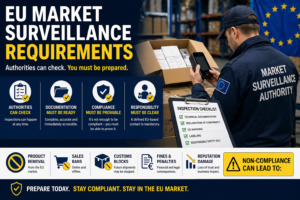
Many companies focus heavily on getting products into the EU market — certifications are completed, logistics are arranged, and distribution channels are activated. However, what often gets overlooked is what happens after market entry. Compliance is not validated at the border; it is validated in the market. This is where EU market surveillance comes into play.
Authorities across the EU actively monitor products that are already in circulation. They conduct inspections, request documentation, and assess whether the compliance structure holds up under real conditions. Unlike customs checks, which are often procedural, market surveillance is targeted and in-depth. Failures at this stage do not result in delays — they result in enforcement actions such as product removals, sales bans, or wider investigations across entire product portfolios.
What Is EU Market Surveillance?
EU market surveillance refers to the activities carried out by national authorities to ensure that products on the market comply with applicable regulations. It is not a one-time check, but an ongoing system designed to detect non-compliant products and enforce corrective actions when necessary.
Market surveillance includes:
- Product inspections
- Documentation requests
- Compliance verification
It happens after market entry.
The Legal Basis
Market surveillance in the EU is primarily governed by Regulation (EU) 2019/1020. This regulation ensures that authorities have the power to verify compliance, request documentation, and take action against non-compliant products. It applies broadly across product categories and economic operators.
Key principle:
👉 Authorities must be able to identify and reach a responsible entity in the EU at any time.
Who Is Affected
Market surveillance applies to all economic operators involved in placing products on the EU market. This includes manufacturers, importers, authorised representatives, and distributors. Responsibility is not optional — it must be clearly defined and operational.
Affected parties:
- EU and non-EU manufacturers
- Importers
- EU Authorised Representatives
- Distributors
Everyone in the supply chain can be involved.
What Authorities Check
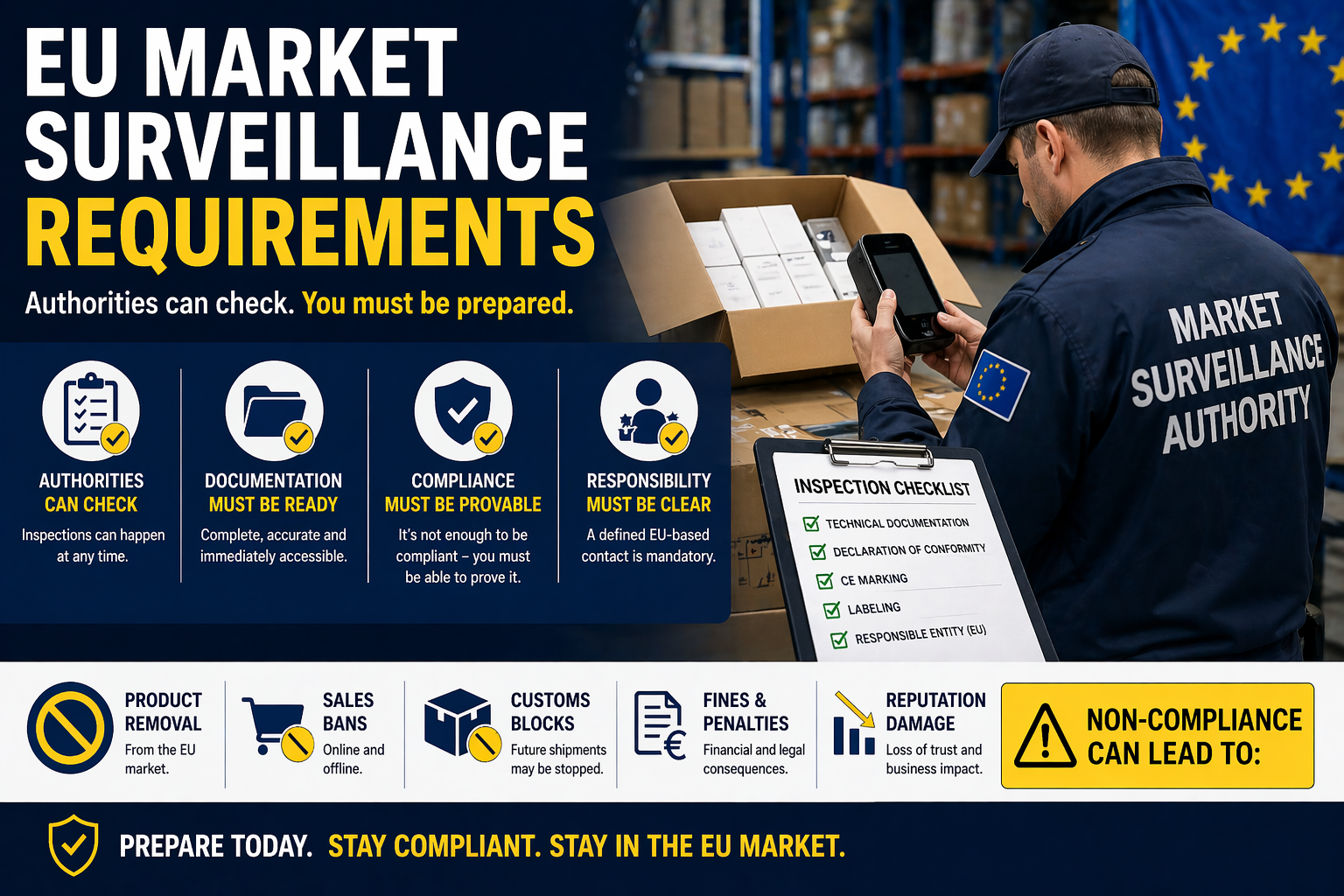
Authorities do not perform random checks without structure. They follow a clear approach focused on verifying compliance in practice. The goal is to ensure that products meet all regulatory requirements and that documentation can be provided immediately.
Authorities typically check:
- Technical documentation
- Declaration of Conformity
- Labeling and CE marking
- Responsible economic operator
They check proof — not assumptions.
The Documentation Requirement
One of the most critical aspects of market surveillance is documentation. Authorities expect complete, product-specific documentation that is immediately accessible. Delays or inconsistencies are treated as compliance failures, regardless of whether the product itself is technically compliant.
Documentation must be:
- Complete and structured
- Product-specific
- Available without delay
If you cannot provide it, you are non-compliant.
Response Time and Accessibility
Market surveillance is time-critical. When authorities request information, companies must respond within defined deadlines. The ability to respond quickly is just as important as having the documentation itself.
Typical requirements:
- Immediate or short-term response
- Clear communication
- Complete information
Slow response = compliance risk.
The Role of the EU Authorised Representative
For non-EU manufacturers, the EU Authorised Representative plays a key role in market surveillance. This entity acts as the official contact point and ensures that authorities can access documentation and communicate effectively.
The EU AR:
- Acts as authority interface
- Provides documentation access
- Supports response processes
Often the deciding factor in enforcement situations.
How Enforcement Starts
Market surveillance is usually triggered by specific events rather than random selection. Once triggered, authorities begin a structured review process that can quickly expand in scope.
Typical triggers:
- Complaints or incidents
- Random inspections
- Market surveillance campaigns
- Competitor reports
You don’t control when it starts.
The Escalation Process
If compliance cannot be verified, the situation escalates. Authorities may expand their investigation beyond a single product and involve additional agencies or jurisdictions. This significantly increases the impact on the business.
Typical escalation:
- Follow-up requests
- Broader product checks
- Cross-border coordination
One issue rarely stays isolated.
The Consequences of Non-Compliance
Failure to meet market surveillance requirements leads to immediate enforcement actions. These actions are designed to remove non-compliant products from the market and prevent further distribution.
Possible consequences:
- Product removal
- Sales bans
- Platform takedowns
- Customs blocks
Impact is fast and direct.
How to Prepare for Market Surveillance
Preparation is the only effective way to handle market surveillance. Companies must ensure that their compliance structure is complete and operational before any authority request occurs.
A robust setup includes:
- Complete technical documentation
- Defined EU-based responsible entity
- Clear communication processes
- EU Authorised Representative (if required)
Compliance must be ready at all times.
The Core Insight
Market surveillance is not about catching mistakes — it is about verifying whether your compliance structure works in reality. Authorities test your setup under real conditions, and any gap becomes immediately visible.
- Compliance is not what you have
- It is what you can prove instantly
Final Thought
EU market surveillance is the point where theory meets reality. Companies that prepare properly handle checks without disruption. Those that rely on assumptions face enforcement actions that can impact their entire business.
- Market entry is easy
- Staying compliant is the challenge
If you are unsure whether your setup is compliant:
👉 We offer a structured compliance screening for non-EU manufacturers.
- review of your current setup
- identification of gaps
- clear recommendations
Contact us to assess your EU compliance status before authorities do.
_______
Tätigkeiten, die der Gesetzgeber Rechtsanwälten, Steuerberatern,
Wirtschaftsprüfern und anderen besonderen Berufsgruppen vorbehalten hat,
gehören gemäß unseren Mandatsvereinbarungen ausdrücklich nicht zu unserem
Mandatsumfang. Werden solche Tätigkeiten erforderlich, so vermitteln wir
unserem Mandanten uns bekannte, seriöse Beratungskollegen aus den
zugelassenen Berufsgruppen.
Unsere Tätigkeit erstreckt sich ausschließlich auf die Ermittlung von
wirtschaftlichen Sachverhalten im Rahmen unseres unternehmens- und
wirtschaftsberatenden Mandates sowie die Vor- und Aufbereitung der aus der
Ermittlung dieser wirtschaftlichen Sachverhalte resultierenden
Entscheidungen und Unterlagen.
Unsere Ratgeber weisen Ihnen den Weg bei beruflichen Problemen. Daher haben
praxisrelevante Fälle für Sie herausgesucht und exemplarisch beantwortet –
ohne Anspruch auf inhaltliche Vollständigkeit. Bitte bedenken Sie, dass
nicht alle denkbaren Besonderheiten des Einzelfalls berücksichtigt sein
können. Die Lektüre des Ratgebers ersetzt keine individuelle Beratung.

_______
Als Werbe-Partner verdienen wir an qualifizierten Käufen von Affiliate-Programmen ( siehe unsere Datenschutzbestimmungen ). Für Sie verändert sich der Preis nicht.
- Auxmoney – 50.000 € Kredite für Selbständige
- SCHUFA-neutraler Kreditvergleich für Selbständige
- AGB-Sicherheitspakete für Online-Händler
- Gasanbieter wechseln – bis zu 750 € sparen
- Stromanbieter wechseln – bis zu 440 € sparen
- Private Krankenversicherung – offizieller Tarifrechner
- Kfz-Versicherung – bis zu 850 € sparen
- Haftpflichtversicherung – bis zu 70 % sparen
- Hausratversicherung – TÜV „sehr gut“
- Rechtsschutzversicherung online berechnen
- DSL-Verfügbarkeitscheck
- Pauschalreisen günstig buchen
- Mietwagen-Preisvergleich