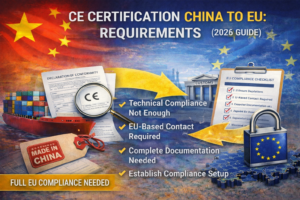
Many Chinese manufacturers invest significant time and resources into obtaining CE certification, assuming that this step alone ensures access to the European Union market. While CE marking is a critical requirement, it is often misunderstood as a complete approval for selling products in the EU. In reality, CE certification only confirms that a product meets specific technical standards, but it does not establish the full legal and organisational framework required for compliance. Without this structure, products may still be stopped at customs, removed from the market, or subject to enforcement actions. Understanding the limitations of CE certification is therefore essential for avoiding costly compliance issues.
What CE Certification Actually Covers
CE certification focuses on technical conformity and demonstrates that a product meets applicable EU directives and standards. It is a declaration by the manufacturer that the product complies with relevant requirements.
- compliance with EU directives
- technical safety and performance verification
- conformity assessment procedures
- documentation of testing and evaluation
What CE Certification Does NOT Cover
Despite its importance, CE certification does not address several key elements that are required for legal market access in the EU. These gaps are often the source of compliance problems.
- no legal presence in the EU
- no defined contact for authorities
- no guarantee of documentation availability
- no operational compliance structure
👉 CE certification confirms the product, not the system behind it.
Additional Requirements for EU Market Access
To legally sell products in the EU, manufacturers must go beyond certification and establish a complete compliance framework.
- Declaration of Conformity
- complete technical documentation
- correct product labelling
- defined economic operator in the EU
Role of the EU Authorised Representative
For Chinese manufacturers, the EU Authorised Representative is essential to ensure that compliance can be verified within the EU. This role provides a local interface for authorities.
- acts as official EU contact
- provides documentation upon request
- ensures communication with authorities
- supports compliance verification
👉 Without an EU-based entity, enforcement cannot function properly.
Common Mistakes in CE Certification for EU
Many manufacturers encounter compliance issues because they misunderstand the scope of CE certification or rely on incomplete setups.
- assuming CE marking is sufficient
- missing EU Authorised Representative
- incomplete or inconsistent documentation
- unclear responsibility structure
What Happens If Requirements Are Not Met
If the full compliance structure is not in place, products may face immediate regulatory issues despite having CE certification.
- shipments may be stopped at customs
- authorities may request documentation
- products may be removed from sale
- compliance investigations may start
Special Risk: Multiple Product Variants
Products with multiple models or variations increase complexity and require consistent documentation across all versions.
- different versions require aligned documentation
- risk of inconsistencies
- increased compliance complexity
- higher likelihood of errors
CE Certification Is Not Market Access
CE certification is only one element of EU compliance and does not guarantee that products can be legally sold.
The key lesson is that manufacturers must build a complete compliance system that includes documentation, legal presence, and defined responsibilities. Without this system, certification alone does not prevent enforcement actions.
How to Ensure Full Compliance
Manufacturers must take a structured approach to ensure that CE certification is supported by a complete compliance setup.
- ensure complete and consistent documentation
- appoint an EU Authorised Representative
- align product and labelling information
- define clear responsibilities
Conclusion
CE certification is a necessary step for entering the EU market, but it is not sufficient on its own. Manufacturers must ensure that all legal, organisational, and documentation requirements are fulfilled to achieve full compliance. Only a complete and structured approach ensures stable and uninterrupted market access.
If you are unsure whether your setup is compliant:
👉 We offer a structured compliance screening for non-EU manufacturers.
- review of your current setup
- identification of gaps
- clear recommendations
Contact us to assess your EU compliance status before authorities do
_______
Tätigkeiten, die der Gesetzgeber Rechtsanwälten, Steuerberatern,
Wirtschaftsprüfern und anderen besonderen Berufsgruppen vorbehalten hat,
gehören gemäß unseren Mandatsvereinbarungen ausdrücklich nicht zu unserem
Mandatsumfang. Werden solche Tätigkeiten erforderlich, so vermitteln wir
unserem Mandanten uns bekannte, seriöse Beratungskollegen aus den
zugelassenen Berufsgruppen.
Unsere Tätigkeit erstreckt sich ausschließlich auf die Ermittlung von
wirtschaftlichen Sachverhalten im Rahmen unseres unternehmens- und
wirtschaftsberatenden Mandates sowie die Vor- und Aufbereitung der aus der
Ermittlung dieser wirtschaftlichen Sachverhalte resultierenden
Entscheidungen und Unterlagen.
Unsere Ratgeber weisen Ihnen den Weg bei beruflichen Problemen. Daher haben
praxisrelevante Fälle für Sie herausgesucht und exemplarisch beantwortet –
ohne Anspruch auf inhaltliche Vollständigkeit. Bitte bedenken Sie, dass
nicht alle denkbaren Besonderheiten des Einzelfalls berücksichtigt sein
können. Die Lektüre des Ratgebers ersetzt keine individuelle Beratung.

_______
Als Werbe-Partner verdienen wir an qualifizierten Käufen von Affiliate-Programmen ( siehe unsere Datenschutzbestimmungen ). Für Sie verändert sich der Preis nicht.
- Auxmoney – 50.000 € Kredite für Selbständige
- SCHUFA-neutraler Kreditvergleich für Selbständige
- AGB-Sicherheitspakete für Online-Händler
- Gasanbieter wechseln – bis zu 750 € sparen
- Stromanbieter wechseln – bis zu 440 € sparen
- Private Krankenversicherung – offizieller Tarifrechner
- Kfz-Versicherung – bis zu 850 € sparen
- Haftpflichtversicherung – bis zu 70 % sparen
- Hausratversicherung – TÜV „sehr gut“
- Rechtsschutzversicherung online berechnen
- DSL-Verfügbarkeitscheck
- Pauschalreisen günstig buchen
- Mietwagen-Preisvergleich