
Many manufacturers assume that compliance issues only arise in theory or affect poorly prepared companies. In reality, even established manufacturers with certified products can face serious regulatory consequences when the compliance structure is incomplete. This case study is based on a real-world scenario involving a non-EU manufacturer selling electronic products in the European Union over several years. The products were actively distributed, technically functional, and already placed on the market at scale. However, once authorities became involved, it became clear that the issue was not technical compliance – but a complete failure of the compliance framework behind it.
Initial Situation: Certified – But Structurally Non-Compliant
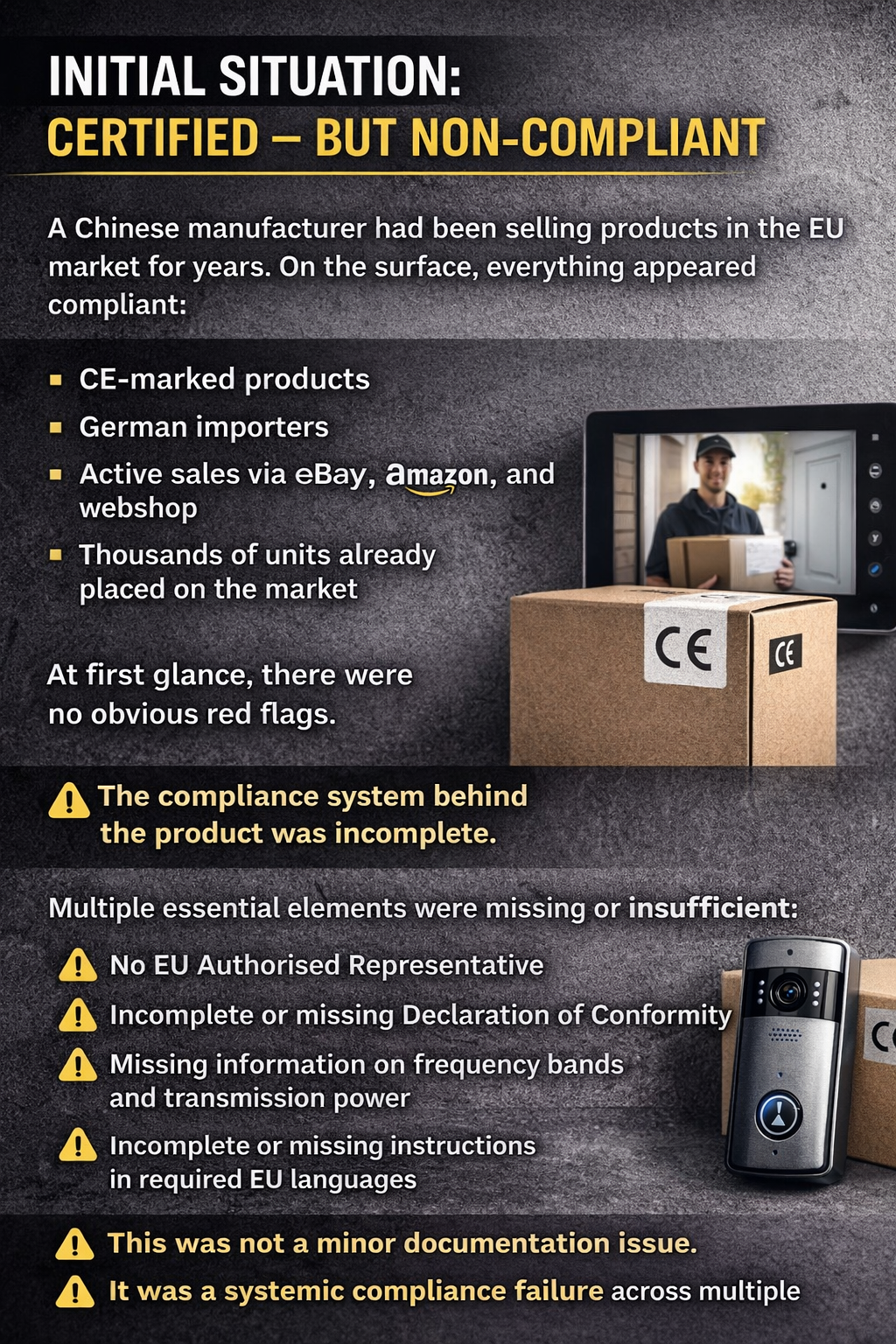
The chinese manufacturer had been selling products in the EU market for years. On the surface, everything appeared compliant:
- CE-marked products
- German importers
- active sales via eBay, Amazon, and webshop
- thousands of units already placed on the market
- technical documentation partially available
At first glance, there were no obvious red flags.
However, a detailed review revealed a critical issue:
👉 The compliance system behind the product was incomplete.
Multiple essential elements were missing or insufficient:
- no EU Authorised Representative
- incomplete or missing Declaration of Conformity
- missing information on frequency bands and transmission power
- incomplete or missing instructions in required EU languages
- incorrect or incomplete product and packaging labelling
👉 This was not a minor documentation issue.
👉 It was a systemic compliance failure across multiple regulatory requirements.
The First Trigger: Formal Market Surveillance and Regulatory Proceedings
The situation did not begin with a simple document request or informal inquiry.
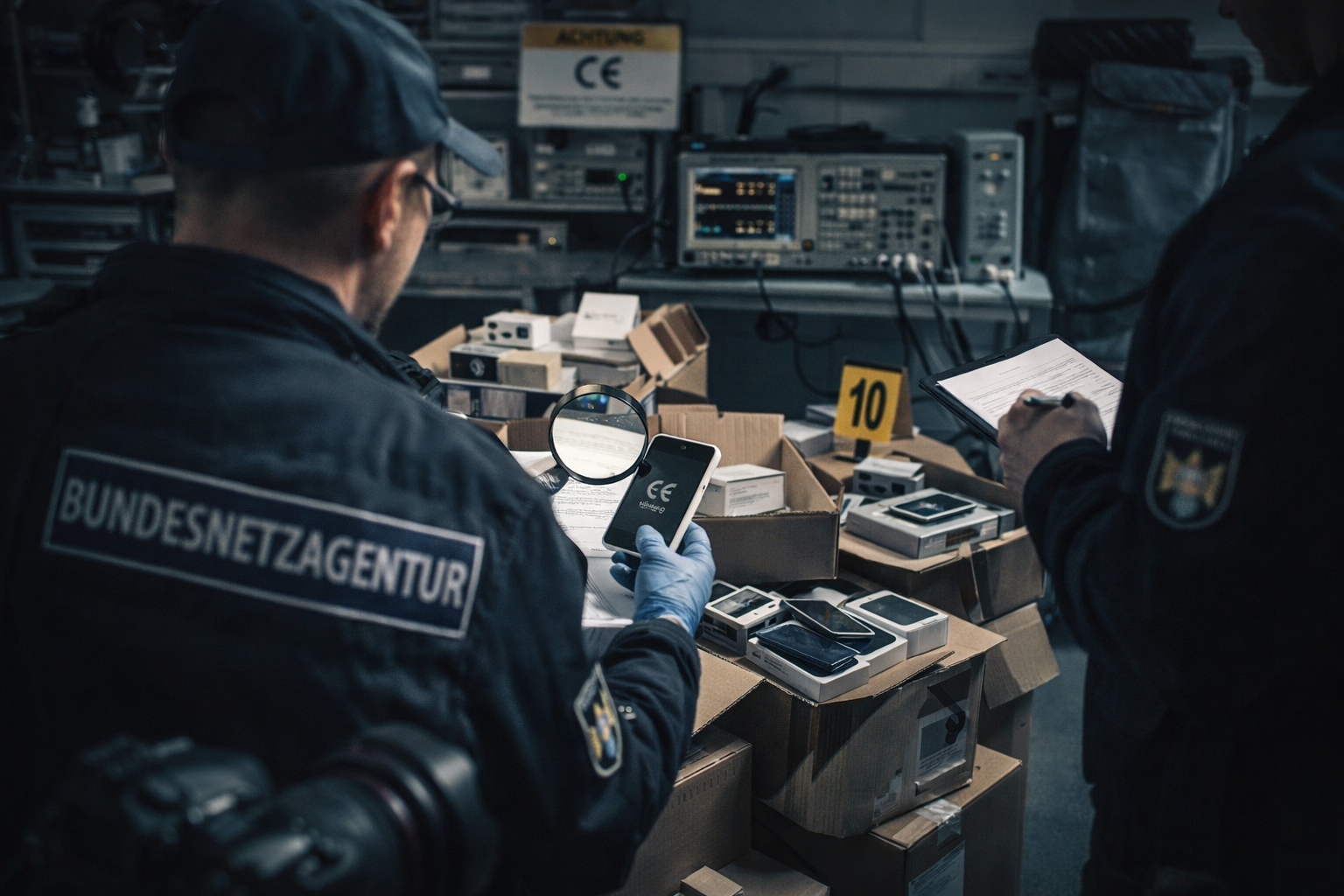
It started with active market surveillance measures carried out by the German Federal Network Agency (Bundesnetzagentur).
As part of these measures, the authority:
- identified the products in the market (e.g. online platforms)
- procured the devices directly from the market (test purchase / sample collection)
- subjected them to administrative and technical review
👉 This is a critical point:
Authorities do not wait for manufacturers to provide documentation.
They actively obtain products themselves.
Following this, the authority initiated a formal regulatory procedure.
The importer was formally accused of placing non-compliant radio equipment on the EU market and administrative offence proceedings were opened.
This was based on findings such as:
- missing or incomplete EU Declaration of Conformity
- missing technical parameters (frequency, transmission power)
- incomplete or incorrect labelling
- lack of a clearly identifiable EU-based responsible entity
👉 At this point, the situation fundamentally changed:
This was no longer a compliance clarification.
👉 It became a formal enforcement case based on real market evidence.
Regulatory Pressure: Immediate and Binding
The authority imposed strict legal requirements:
- mandatory response within a defined deadline
- obligation to provide complete documentation
- risk of fines without further hearing
👉 At this stage, companies can no longer “fix documentation later”.
👉 The burden of proof becomes immediate.
Parallel Action: Market Intervention and Product Control
Authorities did not rely on documentation alone.
- products were taken from the market
- devices were physically inspected
- compliance deficiencies were confirmed
👉 This is critical:
Compliance is not what is written.
It is what can be verified under control.
The Core Problem: Responsibility Was Not Verifiable
At this point, the issue was no longer documentation – it became a fundamental failure of accountability. Authorities were unable to identify a responsible entity within the EU.
In practice:
- no formally appointed EU Authorised Representative
- importer role not structured for compliance
- no central authority contact
- fragmented documentation
- inconsistent information
👉 From a regulatory perspective:
Responsibility exists only if it can be proven immediately.
In this case, it could not.
Escalation: From Gap to Full Enforcement Case
Once identified, the issue escalated rapidly:
- administrative offence proceedings initiated
- repeated authority requests
- strict deadlines imposed
- multiple products under review
- legal pressure increased
👉 The situation shifted from clarification to enforcement.
Operational Impact: Immediate Business Disruption
The consequences were direct and severe:
- immediate stop of sales of related products
- no further imports
- listings effectively blocked
- distribution channels disrupted
👉 The related business was no longer operational.
Supply Chain Reaction
The issue spread across the entire ecosystem:
- distributors questioned compliance
- partners demanded clarification
- trust decreased
- internal effort increased significantly
👉 A single compliance gap triggered a full chain reaction.
Outcome: Limited Penalty – But Full Business Damage
Despite the severity of the violations and the formal regulatory proceedings, the case ended with a relatively limited financial penalty for the importer.
- administrative offence procedure initiated
- sales of the affected products stopped immediately
- information to clients enforced
- formally request to the manufacturer to correct the deficiencies
- no further imports or distribution of related products allowed
- final penalty: approx. €1,000 fine
👉 From a purely financial perspective, this may appear manageable.
However, this does not reflect the real impact:
- complete loss of market access
- products removed from sale
- operational disruption
- internal compliance and legal effort
- reputational damage
- exposure to potential claims
👉 The business impact was significantly higher than the fine itself.
Attempted Remediation: Manufacturer Was Formally Requested to Act
Following the regulatory findings, the importer formally requested the manufacturer to correct the deficiencies.
The manufacturer was required to:
- appoint an EU Authorised Representative
- provide a complete and valid Declaration of Conformity
- deliver missing technical data (frequencies, transmission power)
- correct labelling and documentation
- ensure full compliance with EU requirements
👉 This was a clear and formal request to restore compliance.

Reality Check: Manufacturer Response and resolution pending, importer takes the risks over profit
Even after formal requests and regulatory pressure:
- no complete documentation was delivered
- no EU Authorised Representative was appointed
- no fully compliant structure was implemented
👉 The compliance issue remains unresolved on the manufacturer side.
Despite the severity of the situation, the manufacturer’s response clearly showed a fundamental misunderstanding of EU compliance requirements.
We are already selling in Europe for years without any problems.
We don’t need any services as a representative in the EU, because we plan to open an office in Germany / Europe.
No authority has ever complained about our products.
We did all certificate testing legally.
Our importer is arranging everything.
👉 This response highlights a critical misconception:
- compliance is treated as optional
- responsibility is postponed
- regulatory requirements are underestimated
👉 In reality:
EU compliance is not optional.
And it is not something you fix “in the future”.
At the same time, the importer is fully aware of the situation but does not enforce corrective action.
- the manufacturer has been formally requested to resolve the compliance gaps
- no effective corrective measures have been implemented
- the lack of documentation and missing EU Authorised Representative are known
👉 Despite this, the importer continues to sell products vom this manufacturer.
- no escalation towards the manufacturer
- no suspension of sales
- no structural correction of the compliance setup
👉 Instead, the importer accepts the situation and continues operating under risk.
- commercial interests are prioritised over compliance
- existing stock and margins drive decision-making
- the risk of further investigation is knowingly accepted
👉 The result:
The manufacturer does not act.
The importer does not enforce.
The compliance gap remains — while similar products continue to be sold on the EU market.
Critical Risk: Reopening the Case and Escalating Penalties
The case may appear “closed” from the authority perspective, but the underlying problem still exists.
👉 The risk has not disappeared.
👉 It has only shifted:
- from authority → to importer
- from manufacturer → to EU market
- from compliance → to liability
🔍 What Happens If the Case Is Reopened
If the same products reappear on the market without full compliance, authorities can initiate a new and significantly more severe procedure.
This is not a continuation of the previous case.
👉 It is treated as a new violation.
And this changes everything.
Why the Next Case Will Be More Severe
Authorities already have:
- documented evidence of previous non-compliance
- knowledge of the product and manufacturer
- proof that corrective actions were required
👉 This removes any “benefit of doubt”.
From a regulatory perspective, the situation shifts from:
“possible compliance gap” → to → “known non-compliance”
🔍 Escalation of Enforcement Measures
In such cases, authorities typically escalate measures:
- significantly higher administrative fines
- immediate manufactorer bans
- formal product withdrawal orders
- potential recall obligations
- increased scrutiny across the entire product portfolio
👉 Enforcement becomes faster, stricter, and broader.
🔍 Real Regulatory Pattern
Across EU market surveillance practice, repeat violations are treated much more aggressively.
Typical escalation logic:
- First case
→ warning / moderate fine
→ opportunity to correct - Repeat case
→ higher fines
→ stricter deadlines
→ formal market restrictions - Persistent non-compliance
→ product bans
→ recalls
→ broader investigations
👉 Authorities expect learning and correction after the first case.
If that does not happen, enforcement intensifies.
Final Lesson
This case shows a dangerous pattern:
👉 Manufacturers underestimate EU requirements
👉 Importers carry the legal risk
👉 Authorities enforce compliance – regardless of intention
And most importantly:
👉 A small fine does not mean a small problem.
If you are unsure whether your setup is compliant:
👉 We offer a structured compliance screening for non-EU manufacturers.
- review of your current setup
- identification of gaps
- clear recommendations
Contact us to assess your EU compliance status before authorities do
_______
Tätigkeiten, die der Gesetzgeber Rechtsanwälten, Steuerberatern,
Wirtschaftsprüfern und anderen besonderen Berufsgruppen vorbehalten hat,
gehören gemäß unseren Mandatsvereinbarungen ausdrücklich nicht zu unserem
Mandatsumfang. Werden solche Tätigkeiten erforderlich, so vermitteln wir
unserem Mandanten uns bekannte, seriöse Beratungskollegen aus den
zugelassenen Berufsgruppen.
Unsere Tätigkeit erstreckt sich ausschließlich auf die Ermittlung von
wirtschaftlichen Sachverhalten im Rahmen unseres unternehmens- und
wirtschaftsberatenden Mandates sowie die Vor- und Aufbereitung der aus der
Ermittlung dieser wirtschaftlichen Sachverhalte resultierenden
Entscheidungen und Unterlagen.
Unsere Ratgeber weisen Ihnen den Weg bei beruflichen Problemen. Daher haben
praxisrelevante Fälle für Sie herausgesucht und exemplarisch beantwortet –
ohne Anspruch auf inhaltliche Vollständigkeit. Bitte bedenken Sie, dass
nicht alle denkbaren Besonderheiten des Einzelfalls berücksichtigt sein
können. Die Lektüre des Ratgebers ersetzt keine individuelle Beratung.

_______
Als Werbe-Partner verdienen wir an qualifizierten Käufen von Affiliate-Programmen ( siehe unsere Datenschutzbestimmungen ). Für Sie verändert sich der Preis nicht.
- Auxmoney – 50.000 € Kredite für Selbständige
- SCHUFA-neutraler Kreditvergleich für Selbständige
- AGB-Sicherheitspakete für Online-Händler
- Gasanbieter wechseln – bis zu 750 € sparen
- Stromanbieter wechseln – bis zu 440 € sparen
- Private Krankenversicherung – offizieller Tarifrechner
- Kfz-Versicherung – bis zu 850 € sparen
- Haftpflichtversicherung – bis zu 70 % sparen
- Hausratversicherung – TÜV „sehr gut“
- Rechtsschutzversicherung online berechnen
- DSL-Verfügbarkeitscheck
- Pauschalreisen günstig buchen
- Mietwagen-Preisvergleich