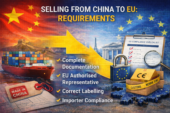
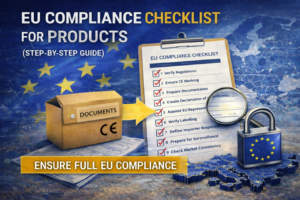
Many manufacturers are unsure whether their products fully meet all EU requirements before entering the market. While certification and documentation may be partially in place, compliance in the European Union depends on a combination of technical, legal, and organisational factors. Missing even a single element can result in delays at customs, requests from authorities, or removal from the market. A structured compliance checklist helps ensure that all requirements are fulfilled before products are shipped, reducing risk and enabling smooth market entry.
Step 1: Verify Applicable EU Regulations
Before placing a product on the EU market, manufacturers must identify which directives and regulations apply. This forms the foundation of all compliance activities.
- identify relevant EU directives
- determine applicable standards
- assess product category requirements
- confirm regulatory scope
Step 2: Ensure CE Marking (If Required)
CE marking is mandatory for many product categories and confirms technical conformity with EU requirements.
- verify CE marking applicability
- complete conformity assessment procedures
- ensure correct use of CE marking
- document compliance process
Step 3: Prepare Technical Documentation
Technical documentation must be complete, structured, and available for authorities at any time.
- technical file preparation
- test reports and certifications
- product specifications
- risk assessments
Step 4: Create Declaration of Conformity
The Declaration of Conformity is a key document that confirms compliance with EU legislation.
- prepare Declaration of Conformity
- ensure correct legal references
- include manufacturer details
- maintain updated versions
Step 5: Appoint an EU Authorised Representative
Non-EU manufacturers must ensure that a responsible entity is established within the EU to handle compliance matters.
- appoint EU-based representative
- define mandate and responsibilities
- ensure documentation access
- establish communication structure
Step 6: Verify Labelling and Product Information
Products must include correct and consistent information to ensure traceability and regulatory compliance.
- manufacturer identification
- EU contact details
- CE marking and symbols
- product identification
Step 7: Define Importer Responsibilities
The importer plays a key role in placing products on the EU market and must ensure compliance is fulfilled.
- verify product compliance
- ensure documentation availability
- confirm labelling requirements
- act as economic operator
Step 8: Prepare for Market Surveillance
Manufacturers must be ready to respond to authority requests at any time after products enter the market.
- ensure documentation accessibility
- define response processes
- assign responsibilities
- prepare for authority interaction
Step 9: Check Consistency Across All Markets
Consistency in documentation and product information is essential to avoid compliance issues.
- align product versions
- ensure consistent labelling
- verify documentation accuracy
- maintain version control
Compliance Is a System, Not a Step
EU compliance cannot be reduced to a single action such as certification or documentation. It requires a structured system that ensures all elements work together.
The key lesson is that manufacturers must think in terms of a complete compliance setup. Only when all steps are aligned can products be placed on the EU market without risk of delays or enforcement actions.
Conclusion
A structured EU compliance checklist helps manufacturers ensure that all requirements are fulfilled before entering the market. By verifying each step in advance, companies can reduce regulatory risks, avoid costly delays, and maintain stable access to the European Union.
If you are unsure whether your setup is compliant:
👉 We offer a structured compliance screening for non-EU manufacturers.
- review of your current setup
- identification of gaps
- clear recommendations
Contact us to assess your EU compliance status before authorities do
_______
Tätigkeiten, die der Gesetzgeber Rechtsanwälten, Steuerberatern,
Wirtschaftsprüfern und anderen besonderen Berufsgruppen vorbehalten hat,
gehören gemäß unseren Mandatsvereinbarungen ausdrücklich nicht zu unserem
Mandatsumfang. Werden solche Tätigkeiten erforderlich, so vermitteln wir
unserem Mandanten uns bekannte, seriöse Beratungskollegen aus den
zugelassenen Berufsgruppen.
Unsere Tätigkeit erstreckt sich ausschließlich auf die Ermittlung von
wirtschaftlichen Sachverhalten im Rahmen unseres unternehmens- und
wirtschaftsberatenden Mandates sowie die Vor- und Aufbereitung der aus der
Ermittlung dieser wirtschaftlichen Sachverhalte resultierenden
Entscheidungen und Unterlagen.
Unsere Ratgeber weisen Ihnen den Weg bei beruflichen Problemen. Daher haben
praxisrelevante Fälle für Sie herausgesucht und exemplarisch beantwortet –
ohne Anspruch auf inhaltliche Vollständigkeit. Bitte bedenken Sie, dass
nicht alle denkbaren Besonderheiten des Einzelfalls berücksichtigt sein
können. Die Lektüre des Ratgebers ersetzt keine individuelle Beratung.

_______
Als Werbe-Partner verdienen wir an qualifizierten Käufen von Affiliate-Programmen ( siehe unsere Datenschutzbestimmungen ). Für Sie verändert sich der Preis nicht.
- Auxmoney – 50.000 € Kredite für Selbständige
- SCHUFA-neutraler Kreditvergleich für Selbständige
- AGB-Sicherheitspakete für Online-Händler
- Gasanbieter wechseln – bis zu 750 € sparen
- Stromanbieter wechseln – bis zu 440 € sparen
- Private Krankenversicherung – offizieller Tarifrechner
- Kfz-Versicherung – bis zu 850 € sparen
- Haftpflichtversicherung – bis zu 70 % sparen
- Hausratversicherung – TÜV „sehr gut“
- Rechtsschutzversicherung online berechnen
- DSL-Verfügbarkeitscheck
- Pauschalreisen günstig buchen
- Mietwagen-Preisvergleich