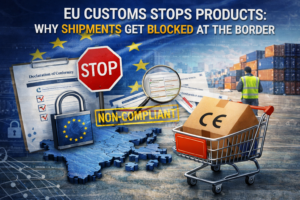
Many manufacturers only become aware of compliance issues when their products are already on the way to the European Union and suddenly get stopped at customs. In most cases, this comes as a surprise, because the products are technically compliant and ready for sale. However, customs authorities do not only check product safety or certification, but also whether all legal and organisational requirements for placing products on the EU market are fulfilled. If key elements such as documentation, traceability, or a clearly defined economic operator are missing or unclear, shipments can be delayed or blocked before they even enter the market.
What Customs Authorities Actually Check
Customs checks go beyond physical inspection and include verification of compliance-related information. Authorities assess whether the product can legally enter the EU market.
- product identification and traceability
- Declaration of Conformity
- presence of required labelling
- identification of responsible economic operator
Why Products Get Stopped
Products are typically stopped when required information is missing, inconsistent, or cannot be verified quickly. Even small gaps can trigger a hold.
- missing or incomplete documentation
- unclear manufacturer or importer details
- absence of EU Authorised Representative
- inconsistencies in product information
The Role of the EU Authorised Representative
The EU Authorised Representative ensures that authorities have a defined point of contact and access to documentation. Without this role, compliance cannot be verified efficiently.
- acts as contact for customs authorities
- provides documentation upon request
- ensures communication structure
- supports clarification of compliance
What Happens When a Shipment Is Stopped
Once a shipment is flagged, the process shifts from routine clearance to a compliance review. This can create delays and operational disruption.
- shipment may be held for inspection
- additional documents may be requested
- clearance may be delayed
- further checks may be initiated
Possible Outcomes
If the situation cannot be resolved quickly, customs may escalate the case or take further action depending on the severity of the issue.
- release after clarification
- extended delays
- refusal of entry into the EU
- referral to market surveillance authorities
Why This Becomes a Serious Risk
Customs stops are not just isolated events but can trigger wider consequences if compliance issues are identified.
- repeated checks on future shipments
- increased scrutiny by authorities
- impact on multiple product lines
- disruption of supply chains
👉 A single issue can quickly expand into a broader compliance problem.
Special Risk: High-Volume and E-Commerce Shipments
Shipments linked to e-commerce or high-volume distribution are more visible and more likely to be checked systematically.
- frequent shipments increase exposure
- easier traceability across platforms
- higher likelihood of pattern detection
- faster escalation of issues
Lesson Learned: Customs Is the First Compliance Test
Customs is often the first point where compliance is tested under real conditions. If the structure behind the product is not complete, issues will surface immediately.
The key lesson for manufacturers is that compliance must be fully in place before products are shipped, not after they are stopped. A complete setup ensures that documentation is available, responsibilities are clear, and authorities can verify compliance without delay.
How to Avoid Customs Stops
Preventing customs issues requires preparation and a structured compliance approach before shipment.
- ensure complete and consistent documentation
- appoint an EU Authorised Representative
- verify labelling and product information
- define clear responsibilities
Conclusion
Customs stops are a direct consequence of incomplete compliance structures and can occur even when products are technically compliant. Manufacturers must ensure that all legal, organisational, and documentation requirements are fulfilled before shipping products to the EU. A proactive approach to compliance is essential to avoid delays, disruptions, and potential market access issues.
If you are unsure whether your setup is compliant:
👉 We offer a structured compliance screening for non-EU manufacturers.
- review of your current setup
- identification of gaps
- clear recommendations
Contact us to assess your EU compliance status before authorities do
_______
Tätigkeiten, die der Gesetzgeber Rechtsanwälten, Steuerberatern,
Wirtschaftsprüfern und anderen besonderen Berufsgruppen vorbehalten hat,
gehören gemäß unseren Mandatsvereinbarungen ausdrücklich nicht zu unserem
Mandatsumfang. Werden solche Tätigkeiten erforderlich, so vermitteln wir
unserem Mandanten uns bekannte, seriöse Beratungskollegen aus den
zugelassenen Berufsgruppen.
Unsere Tätigkeit erstreckt sich ausschließlich auf die Ermittlung von
wirtschaftlichen Sachverhalten im Rahmen unseres unternehmens- und
wirtschaftsberatenden Mandates sowie die Vor- und Aufbereitung der aus der
Ermittlung dieser wirtschaftlichen Sachverhalte resultierenden
Entscheidungen und Unterlagen.
Unsere Ratgeber weisen Ihnen den Weg bei beruflichen Problemen. Daher haben
praxisrelevante Fälle für Sie herausgesucht und exemplarisch beantwortet –
ohne Anspruch auf inhaltliche Vollständigkeit. Bitte bedenken Sie, dass
nicht alle denkbaren Besonderheiten des Einzelfalls berücksichtigt sein
können. Die Lektüre des Ratgebers ersetzt keine individuelle Beratung.

_______
Als Werbe-Partner verdienen wir an qualifizierten Käufen von Affiliate-Programmen ( siehe unsere Datenschutzbestimmungen ). Für Sie verändert sich der Preis nicht.
- Auxmoney – 50.000 € Kredite für Selbständige
- SCHUFA-neutraler Kreditvergleich für Selbständige
- AGB-Sicherheitspakete für Online-Händler
- Gasanbieter wechseln – bis zu 750 € sparen
- Stromanbieter wechseln – bis zu 440 € sparen
- Private Krankenversicherung – offizieller Tarifrechner
- Kfz-Versicherung – bis zu 850 € sparen
- Haftpflichtversicherung – bis zu 70 % sparen
- Hausratversicherung – TÜV „sehr gut“
- Rechtsschutzversicherung online berechnen
- DSL-Verfügbarkeitscheck
- Pauschalreisen günstig buchen
- Mietwagen-Preisvergleich