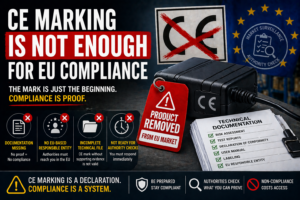
Many manufacturers believe that once a product carries the CE marking, it is fully compliant and can be freely sold across the European Union without further requirements. This assumption is widespread because CE marking is often perceived as a comprehensive approval that covers all regulatory aspects. In reality, CE marking only confirms technical conformity under specific directives, but it does not establish the legal and organisational framework required for market access. Compliance in the EU depends not only on product characteristics, but also on whether there is a clearly defined structure that ensures accountability, documentation access, and communication with authorities.
What CE Marking Actually Covers
CE marking focuses on technical conformity and confirms that a product meets the essential requirements defined in applicable EU legislation. It is a necessary component of compliance, but it represents only one part of the overall regulatory framework.
- conformity with applicable EU directives
- technical safety and performance requirements
- completion of conformity assessment procedures
What CE Marking Does NOT Cover
While CE marking is essential, it does not address key legal and organisational requirements that are critical for enforcement and market access. These gaps are the reason why CE-marked products can still be considered non-compliant.
- no legal presence within the EU
- no defined contact point for authorities
- no guarantee of documentation accessibility
- no structured compliance process
The Missing Link: Legal and Organisational Structure
Beyond technical compliance, EU regulations require a structure that allows authorities to verify and enforce obligations at any time. Without this structure, compliance cannot be demonstrated effectively in practice.
- clearly defined economic operator within the EU
- structured and accessible technical documentation
- defined communication interface for authorities
- operational response capability
👉CE marking alone does not provide this structure.
Real-World Consequences
When CE marking is treated as sufficient on its own, issues typically arise only after products are already placed on the market and become subject to checks. At that point, compliance must be proven under real conditions.
- customs may stop shipments
- authorities may request documentation
- products may be removed from sale
- compliance investigations may be initiated
👉These situations often occur without prior warning.
Why This Misunderstanding Is So Common
The misconception is driven by a strong focus on certification and testing, while legal and organisational requirements are often underestimated or misunderstood during market entry.
- overreliance on CE certification
- lack of understanding of EU compliance structure
- assumption that importers handle all obligations
- incomplete compliance planning
👉 This creates a gap between perceived and actual compliance.
The Role of the EU Authorised Representative
The EU Authorised Representative ensures that a compliant structure exists within the EU and that authorities have a defined and reachable contact point. This role makes compliance operational.
- acts as official contact for authorities
- provides access to documentation
- ensures communication flow
- supports handling of authority requests
👉 Without this role, enforcement becomes difficult and risk increases.
Compliance Beyond Certification
True compliance in the EU requires combining technical conformity with an operational structure that supports ongoing verification and enforcement.
- consistent and up-to-date documentation
- aligned product and labelling information
- clearly defined responsibilities
- structured response processes
👉Certification alone cannot fulfil these requirements.
Certification Is Only One Layer
CE marking is an essential foundation, but it is only one layer of compliance. Manufacturers must understand that EU market access depends on both technical conformity and a functioning legal and organisational structure.
The key takeaway is that compliance must be built as a system, not treated as a single step. Manufacturers who rely only on certification expose themselves to enforcement risks, while those who implement a complete structure ensure stable and scalable market access.
Conclusion
CE marking is necessary, but it is not sufficient to ensure compliance in the European Union. Without a complete framework that includes legal presence, documentation accessibility, and defined responsibilities, products remain exposed to regulatory action. A structured approach to compliance is therefore essential for maintaining uninterrupted access to the EU market.
If you are unsure whether your setup is compliant:
👉 We offer a structured compliance screening for non-EU manufacturers.
- review of your current setup
- identification of gaps
- clear recommendations
Contact us to assess your EU compliance status before authorities do
_______
Tätigkeiten, die der Gesetzgeber Rechtsanwälten, Steuerberatern,
Wirtschaftsprüfern und anderen besonderen Berufsgruppen vorbehalten hat,
gehören gemäß unseren Mandatsvereinbarungen ausdrücklich nicht zu unserem
Mandatsumfang. Werden solche Tätigkeiten erforderlich, so vermitteln wir
unserem Mandanten uns bekannte, seriöse Beratungskollegen aus den
zugelassenen Berufsgruppen.
Unsere Tätigkeit erstreckt sich ausschließlich auf die Ermittlung von
wirtschaftlichen Sachverhalten im Rahmen unseres unternehmens- und
wirtschaftsberatenden Mandates sowie die Vor- und Aufbereitung der aus der
Ermittlung dieser wirtschaftlichen Sachverhalte resultierenden
Entscheidungen und Unterlagen.
Unsere Ratgeber weisen Ihnen den Weg bei beruflichen Problemen. Daher haben
praxisrelevante Fälle für Sie herausgesucht und exemplarisch beantwortet –
ohne Anspruch auf inhaltliche Vollständigkeit. Bitte bedenken Sie, dass
nicht alle denkbaren Besonderheiten des Einzelfalls berücksichtigt sein
können. Die Lektüre des Ratgebers ersetzt keine individuelle Beratung.

_______
Als Werbe-Partner verdienen wir an qualifizierten Käufen von Affiliate-Programmen ( siehe unsere Datenschutzbestimmungen ). Für Sie verändert sich der Preis nicht.
- Auxmoney – 50.000 € Kredite für Selbständige
- SCHUFA-neutraler Kreditvergleich für Selbständige
- AGB-Sicherheitspakete für Online-Händler
- Gasanbieter wechseln – bis zu 750 € sparen
- Stromanbieter wechseln – bis zu 440 € sparen
- Private Krankenversicherung – offizieller Tarifrechner
- Kfz-Versicherung – bis zu 850 € sparen
- Haftpflichtversicherung – bis zu 70 % sparen
- Hausratversicherung – TÜV „sehr gut“
- Rechtsschutzversicherung online berechnen
- DSL-Verfügbarkeitscheck
- Pauschalreisen günstig buchen
- Mietwagen-Preisvergleich