Assuming the role of EU Authorised Representative (EU AR) is not a formal or administrative exercise. It is a legally exposed role that involves direct interaction with EU market surveillance authorities, responsibility for documentation availability, and potential liability implications.
Despite this, many manufacturers — and even notified bodies — still underestimate the importance of a structured pre-screening before an EU AR mandate is issued.
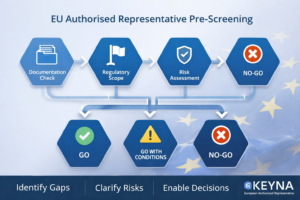
A professional pre-screening protects both sides:
- the manufacturer, by identifying gaps early,
- and the EU Authorised Representative, by avoiding uninsurable or non-manageable mandates.
What an EU Authorised Representative Pre-Screening Is – and Is Not
What the Pre-Screening Covers
An EU AR pre-screening is a document-based feasibility assessment focused on:
- formal availability and allocation of required documentation,
- identification of the applicable and non-applicable EU regulatory framework,
- clarification of product scope, variants, and responsibilities,
- high-level consistency and plausibility checks.
What the Pre-Screening Explicitly Does Not Include
To avoid any misunderstanding, a proper pre-screening explicitly excludes:
- technical verification or validation of documents,
- assessment of test results or product performance,
- CE conformity or compliance assessment,
- audits, inspections, or testing activities,
- involvement in product design, development, or modification,
- assumption of manufacturer obligations.
The outcome is therefore not a conformity statement, but a mandate feasibility decision.
The Structured Pre-Screening Methodology
1. Documentation Review – Formal Completeness Only
The first step evaluates whether mandate-critical documentation exists and is formally allocated.
- Corporate & Quality Structure
- Typical documents reviewed:
- company profile or brochure,
- organisation chart (including production site),
- ISO 9001 certificate,
- legal entity information,
- contact and escalation structure,
- designated contact person for EU market surveillance.
This step answers one simple question:
Is the manufacturer organisationally capable of supporting an EU AR mandate?
Compliance & Post-Market Framework
Key elements reviewed:
- Manufacturer Declaration of Responsibility,
- Conformity of Production (CoP) plan,
- authority notification process,
- market surveillance handling procedure,
- complaints and incident handling process,
- recall flow (including OEM interfaces, where applicable).
At this stage, draft or preparatory documents may be acceptable, but missing post-market processes are a critical risk indicator.
Product-Specific Documentation
Depending on the regulatory context, this includes:
- information document (e.g. according to Delegated Regulation (EU) No. 44/2014, Annex IX),
- confirmation that a draft version is acceptable for screening.
No technical review is performed — only existence and formal relevance.
Product Scope Confirmation
The EU AR mandate is scope-specific.
Therefore, the pre-screening verifies:
- number of STUs,
- number of variants,
- variant differentiation logic.
Unclear scope equals unmanageable liability.
2. Regulatory Framework Identification (Indicative)
The second step defines which EU legislation is relevant and which is not, strictly for scope definition purposes.
This typically includes:
- applicable sector-specific legislation (e.g. Regulation (EU) No. 168/2013),
- delegated or implementing acts (e.g. Delegated Regulation (EU) No. 44/2014),
- clarification of horizontal legislation relevance (e.g. Regulation (EU) 2019/1020).
- Non-applicable legislation is marked as:
- Not applicable for the type-approval scope, or
- Not assessed / not in scope.
This avoids false absolute statements while keeping the regulatory scope transparent.
3. Findings: Documentation Status & Plausibility
Documentation Status Assessment
Each documentation area is classified as:
- Complete – all mandate-relevant documents available,
- Partial – core documents available, but gaps or drafts exist,
- Insufficient – key documents missing, preventing mandate feasibility assessment.
This classification alone often determines whether a mandate is realistic at the current stage.
Consistency & Plausibility Check
A high-level plausibility review checks whether:
- product description,
- regulatory framework,
- declared product scope
are internally consistent.
Again, this is not a technical validation, but a sanity check to identify obvious contradictions.
Risk Assessment from the EU AR Perspective
Based on the findings, a qualitative risk assessment is performed covering:
- Regulatory risk
(e.g. pending approvals, unclear scope, incomplete authority processes) - Product safety risk
(purely indicative, no technical judgement) - Post-market / authority interaction risk
(market surveillance readiness, recall handling) - Insurance & liability perspective
(insurability and coverage prerequisites)
This step is essential, as insurance confirmation is mandatory before any EU Authorised Representative (EU AR) contract can be concluded.
Decision Outcomes: GO / GO WITH CONDITIONS / NO-GO
The pre-screening concludes with one of three decisions:
GO
The EU Authorised Representative mandate is generally feasible based on the documentation status and risk profile.
GO WITH CONDITIONS
The mandate is feasible only after defined gaps are closed, such as:
- receipt of final authority-submitted test and audit reports,
- completion of post-market and authority procedures,
- confirmation of final product scope and variants,
- successful insurance coverage confirmation.
This is the most common and realistic outcome.
NO-GO
The mandate is not feasible due to fundamental documentation gaps, regulatory inconsistencies, or unmanageable risk exposure.
Why Pre-Screening Protects Both Manufacturer and EU AR
A structured pre-screening:
- prevents unrealistic expectations,
- avoids late-stage mandate withdrawal,
- reduces authority escalation risks,
- enables transparent pricing and insurance alignment,
- establishes a professional compliance baseline.
In short:
Pre-screening is not an obstacle — it is risk management.
Next Steps After a GO WITH CONDITIONS Decision
Typical next steps include:
- follow-up pre-screening after document completion,
- final scope and risk confirmation,
- insurance coverage validation,
- issuance of a formal EU Authorised Representative agreement.
Each step is transparent, documented, and contractually separated.
Conclusion: Pre-Screening as a Professional Standard
EU Authorised Representative services require more than availability — they require structure, clarity, and risk awareness.
A formal pre-screening transforms the EU AR role from a vague obligation into a controlled, insurable, and manageable mandate.
That is why pre-screening should be the standard entry point for any serious EU Authorised Representative engagement.
___
Disclaimer: This summary is provided for informational purposes only and does not constitute legal advice. For detailed risk assessments and specific legal guidance, please consult with a qualified legal professional.
_______
Tätigkeiten, die der Gesetzgeber Rechtsanwälten, Steuerberatern,
Wirtschaftsprüfern und anderen besonderen Berufsgruppen vorbehalten hat,
gehören gemäß unseren Mandatsvereinbarungen ausdrücklich nicht zu unserem
Mandatsumfang. Werden solche Tätigkeiten erforderlich, so vermitteln wir
unserem Mandanten uns bekannte, seriöse Beratungskollegen aus den
zugelassenen Berufsgruppen.
Unsere Tätigkeit erstreckt sich ausschließlich auf die Ermittlung von
wirtschaftlichen Sachverhalten im Rahmen unseres unternehmens- und
wirtschaftsberatenden Mandates sowie die Vor- und Aufbereitung der aus der
Ermittlung dieser wirtschaftlichen Sachverhalte resultierenden
Entscheidungen und Unterlagen.
Unsere Ratgeber weisen Ihnen den Weg bei beruflichen Problemen. Daher haben
praxisrelevante Fälle für Sie herausgesucht und exemplarisch beantwortet –
ohne Anspruch auf inhaltliche Vollständigkeit. Bitte bedenken Sie, dass
nicht alle denkbaren Besonderheiten des Einzelfalls berücksichtigt sein
können. Die Lektüre des Ratgebers ersetzt keine individuelle Beratung.

_______
Als Werbe-Partner verdienen wir an qualifizierten Käufen von Affiliate-Programmen ( siehe unsere Datenschutzbestimmungen ). Für Sie verändert sich der Preis nicht.
- Auxmoney – 50.000 € Kredite für Selbständige
- SCHUFA-neutraler Kreditvergleich für Selbständige
- AGB-Sicherheitspakete für Online-Händler
- Gasanbieter wechseln – bis zu 750 € sparen
- Stromanbieter wechseln – bis zu 440 € sparen
- Private Krankenversicherung – offizieller Tarifrechner
- Kfz-Versicherung – bis zu 850 € sparen
- Haftpflichtversicherung – bis zu 70 % sparen
- Hausratversicherung – TÜV „sehr gut“
- Rechtsschutzversicherung online berechnen
- DSL-Verfügbarkeitscheck
- Pauschalreisen günstig buchen
- Mietwagen-Preisvergleich