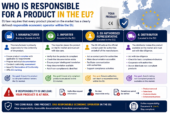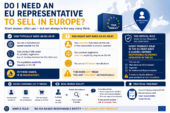
The distinction between AEO and an EU Authorised Representative is often misunderstood. Many companies assume that customs-related certifications automatically cover product compliance. This confusion creates a dangerous blind spot, where responsibilities are unclear and regulatory requirements are only partially fulfilled — until authorities take a closer look.
Many companies assume:
“We have AEO status — we are covered.”
“Our importer handles everything.”
Both assumptions are wrong. Because AEO (Authorized Economic Operator) and an EU Authorised Representative (EU AR) serve completely different purposes in EU law.
The Core Difference
At a high level, AEO and EU AR address entirely different aspects of operating in the EU market. One focuses on the movement of goods, while the other defines legal accountability. Understanding this distinction is critical, as mixing these roles leads to structural compliance gaps.
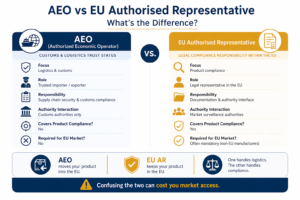
- AEO = Customs & logistics trust status
- EU AR = Legal compliance responsibility within the EU
They are not interchangeable.
They do not overlap.
And having one does not replace the other.
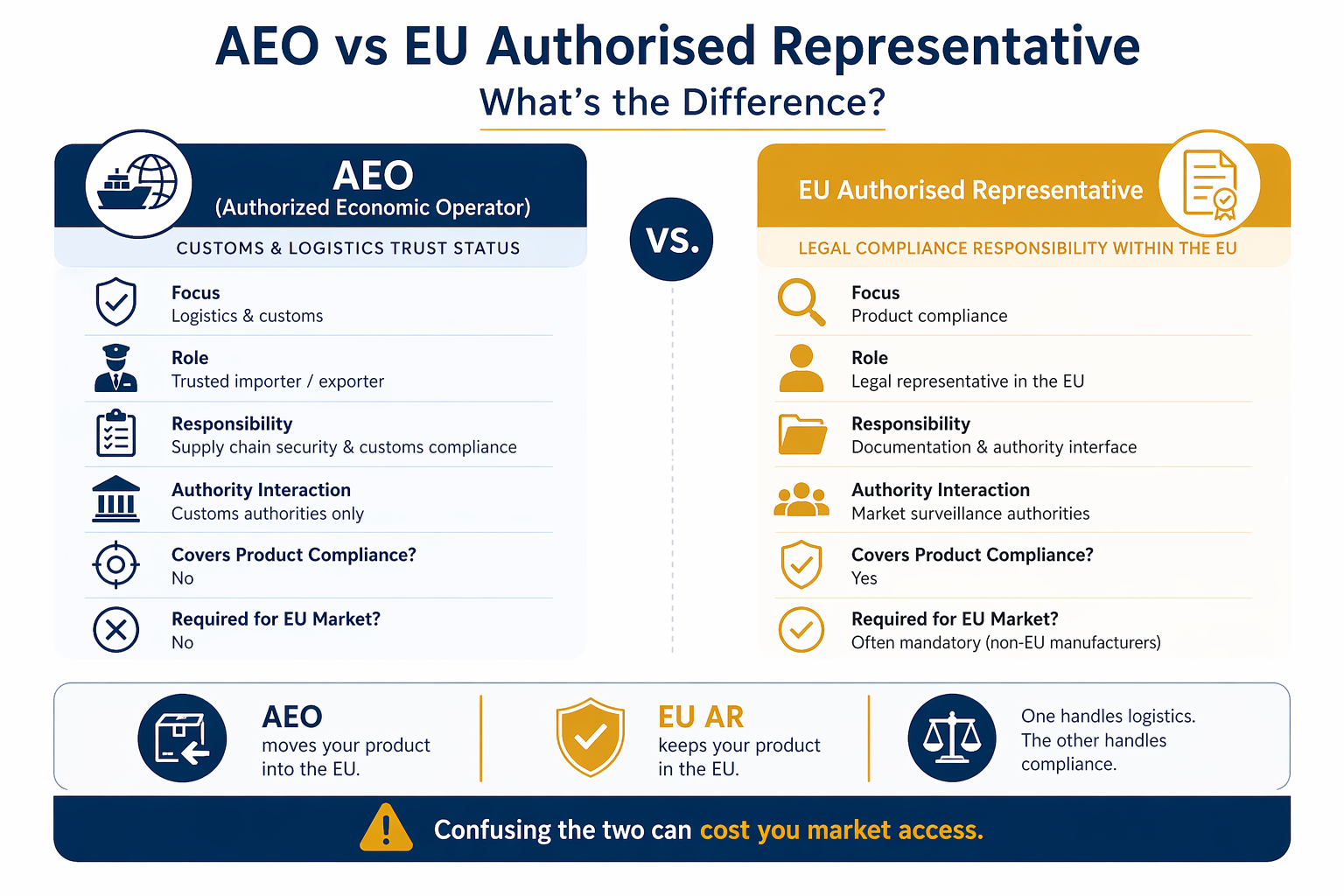
What Is an AEO (Authorized Economic Operator)?
AEO status is designed to facilitate international trade by recognizing companies as reliable partners in customs processes. It improves efficiency and reduces friction at borders. However, its scope is strictly limited to logistics and supply chain security, not product-level regulatory compliance.
An Authorized Economic Operator (AEO) is a status granted by customs authorities.
It confirms that a company is:
- Reliable in customs processes
- Secure in its supply chain
- Compliant with import/export procedures
Benefits of AEO:
- Simplified customs procedures
- Fewer physical inspections
- Faster border clearance
- Trusted trader status
AEO is about movement of goods.
What Is an EU Authorised Representative?
An EU Authorised Representative plays a central role in ensuring that non-EU manufacturers meet regulatory obligations. This role is legally defined and directly connected to market surveillance. It ensures that authorities have a responsible entity within the EU who can provide documentation and respond to compliance inquiries.
An EU Authorised Representative (EU AR) is a legally appointed entity within the EU.
It acts as the official contact point for authorities regarding product compliance.
Key responsibilities:
- Holding technical documentation
- Communicating with market surveillance authorities
- Supporting compliance verification
- Acting on behalf of the manufacturer (within mandate scope)
EU AR is about product compliance and legal accountability.
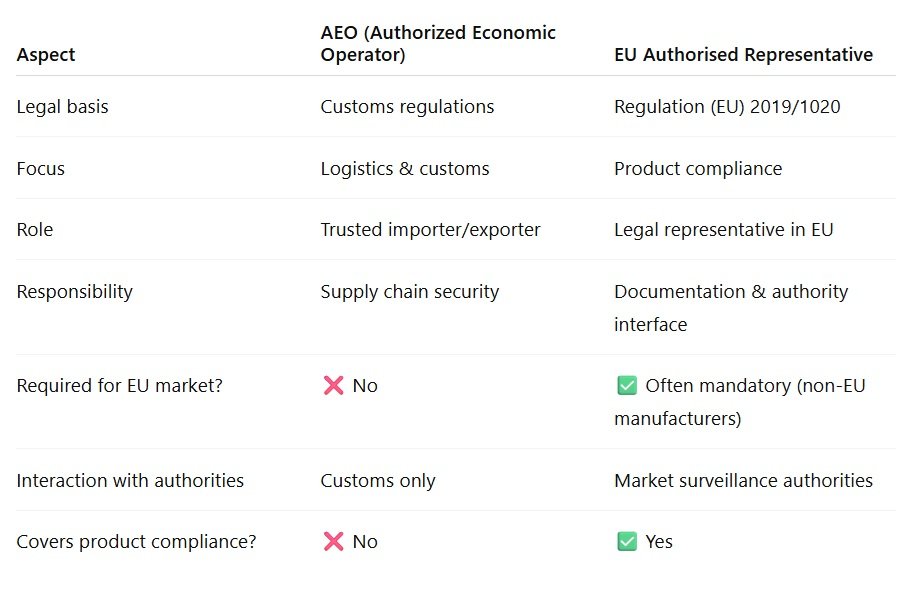
Side-by-Side Comparison
Comparing AEO and EU AR highlights how fundamentally different these roles are. While both are relevant in international trade, they operate in separate regulatory domains. A structured comparison helps clarify responsibilities and prevents the common mistake of assuming overlap where none exists.
Why This Misunderstanding Matters
Misinterpreting these roles is not just a theoretical issue — it has direct operational consequences. Companies that rely on the wrong assumptions often discover gaps only when authorities intervene. At that point, resolving the issue becomes significantly more complex and costly.
Typical situation:
- Manufacturer outside EU
- AEO-certified importer or logistics partner
- No formally appointed EU AR
- Incomplete or inaccessible documentation
Result:
- Authorities request documentation
- No responsible EU entity available
- Products flagged or removed
The Critical Point
The key takeaway is simple but often overlooked: AEO status does not address product compliance requirements. Despite this, many organizations rely on it as a substitute. This misconception creates a false sense of security that can quickly collapse under regulatory scrutiny.
- AEO does not cover product compliance
- AEO does not replace an EU AR
- AEO does not interact with market surveillance authorities
Yet many companies rely on it as if it does.
Real-World Risk Scenario
In practice, compliance failures rarely occur at customs entry. Instead, they emerge later when authorities request documentation or investigate products already on the market. These situations reveal whether responsibilities have been properly defined — or whether critical roles are missing.
A product enters the EU:
- Customs clearance → smooth (AEO works) ✅
- Market surveillance request → failure ❌
Because:
- No EU AR
- No accessible documentation
- No clear responsible entity
That’s where enforcement begins.
How to Structure It Correctly
A compliant setup requires clear separation of roles and responsibilities. Each entity involved in placing products on the EU market must fulfill a specific function. When these roles are properly defined and documented, the overall compliance structure becomes stable and defensible.
A compliant setup clearly separates roles:
- Manufacturer → product responsibility
- Importer → market placement
- EU Authorised Representative → compliance interface
- AEO entity (if applicable) → customs efficiency
Each role has a specific function.
Mixing them creates risk.
Final Thought
Understanding the difference between AEO and EU AR is not just about definitions — it is about ensuring market access. Companies that align their structure with regulatory logic reduce risk and improve resilience when facing authority requests or compliance checks.
- AEO moves your product into the EU
- EU AR keeps your product in the EU
One handles logistics.
The other handles compliance.
Confusing the two can cost you market access.
If you are unsure whether your setup is compliant:
👉 We offer a structured compliance screening for non-EU manufacturers.
- review of your current setup
- identification of gaps
- clear recommendations
Contact us to assess your EU compliance status before authorities do.
_______
Tätigkeiten, die der Gesetzgeber Rechtsanwälten, Steuerberatern,
Wirtschaftsprüfern und anderen besonderen Berufsgruppen vorbehalten hat,
gehören gemäß unseren Mandatsvereinbarungen ausdrücklich nicht zu unserem
Mandatsumfang. Werden solche Tätigkeiten erforderlich, so vermitteln wir
unserem Mandanten uns bekannte, seriöse Beratungskollegen aus den
zugelassenen Berufsgruppen.
Unsere Tätigkeit erstreckt sich ausschließlich auf die Ermittlung von
wirtschaftlichen Sachverhalten im Rahmen unseres unternehmens- und
wirtschaftsberatenden Mandates sowie die Vor- und Aufbereitung der aus der
Ermittlung dieser wirtschaftlichen Sachverhalte resultierenden
Entscheidungen und Unterlagen.
Unsere Ratgeber weisen Ihnen den Weg bei beruflichen Problemen. Daher haben
praxisrelevante Fälle für Sie herausgesucht und exemplarisch beantwortet –
ohne Anspruch auf inhaltliche Vollständigkeit. Bitte bedenken Sie, dass
nicht alle denkbaren Besonderheiten des Einzelfalls berücksichtigt sein
können. Die Lektüre des Ratgebers ersetzt keine individuelle Beratung.

_______
Als Werbe-Partner verdienen wir an qualifizierten Käufen von Affiliate-Programmen ( siehe unsere Datenschutzbestimmungen ). Für Sie verändert sich der Preis nicht.
- Auxmoney – 50.000 € Kredite für Selbständige
- SCHUFA-neutraler Kreditvergleich für Selbständige
- AGB-Sicherheitspakete für Online-Händler
- Gasanbieter wechseln – bis zu 750 € sparen
- Stromanbieter wechseln – bis zu 440 € sparen
- Private Krankenversicherung – offizieller Tarifrechner
- Kfz-Versicherung – bis zu 850 € sparen
- Haftpflichtversicherung – bis zu 70 % sparen
- Hausratversicherung – TÜV „sehr gut“
- Rechtsschutzversicherung online berechnen
- DSL-Verfügbarkeitscheck
- Pauschalreisen günstig buchen
- Mietwagen-Preisvergleich