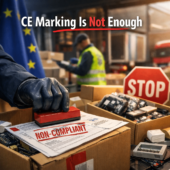

Many manufacturers assume that a single certificate is enough to ensure EU compliance. On the surface, this seems efficient and logical. However, this approach often hides fundamental structural issues. What appears compliant in documentation can quickly become a serious risk once authorities begin to examine the full product portfolio.
“We have one certificate. We are compliant.”
At first glance, this sounds reasonable. Certification has been completed, documentation exists, and products are already on the market. But in reality, this assumption is one of the most common — and most critical — compliance mistakes in the EU market.
Because what looks like efficiency is often a structural failure.
The Real Problem: Product Catalogues vs. Compliance Logic
At first glance, grouping multiple products under one certification appears efficient. It simplifies documentation and reduces effort. However, this approach conflicts with how EU compliance is actually structured. What works internally often fails under regulatory scrutiny — because authorities assess products individually, not as part of a catalogue.
In practice, many manufacturers structure their compliance like this:
- A large product catalogue (often 10–50+ models)
- Slight variations between models (design, frequency, components)
- One certificate covering a “product family”
- One generic Declaration of Conformity
From an internal perspective, this seems efficient. From a regulatory perspective, it creates a serious problem.
- EU compliance is not built around catalogues.
- It is built around individual products and their specific characteristics.
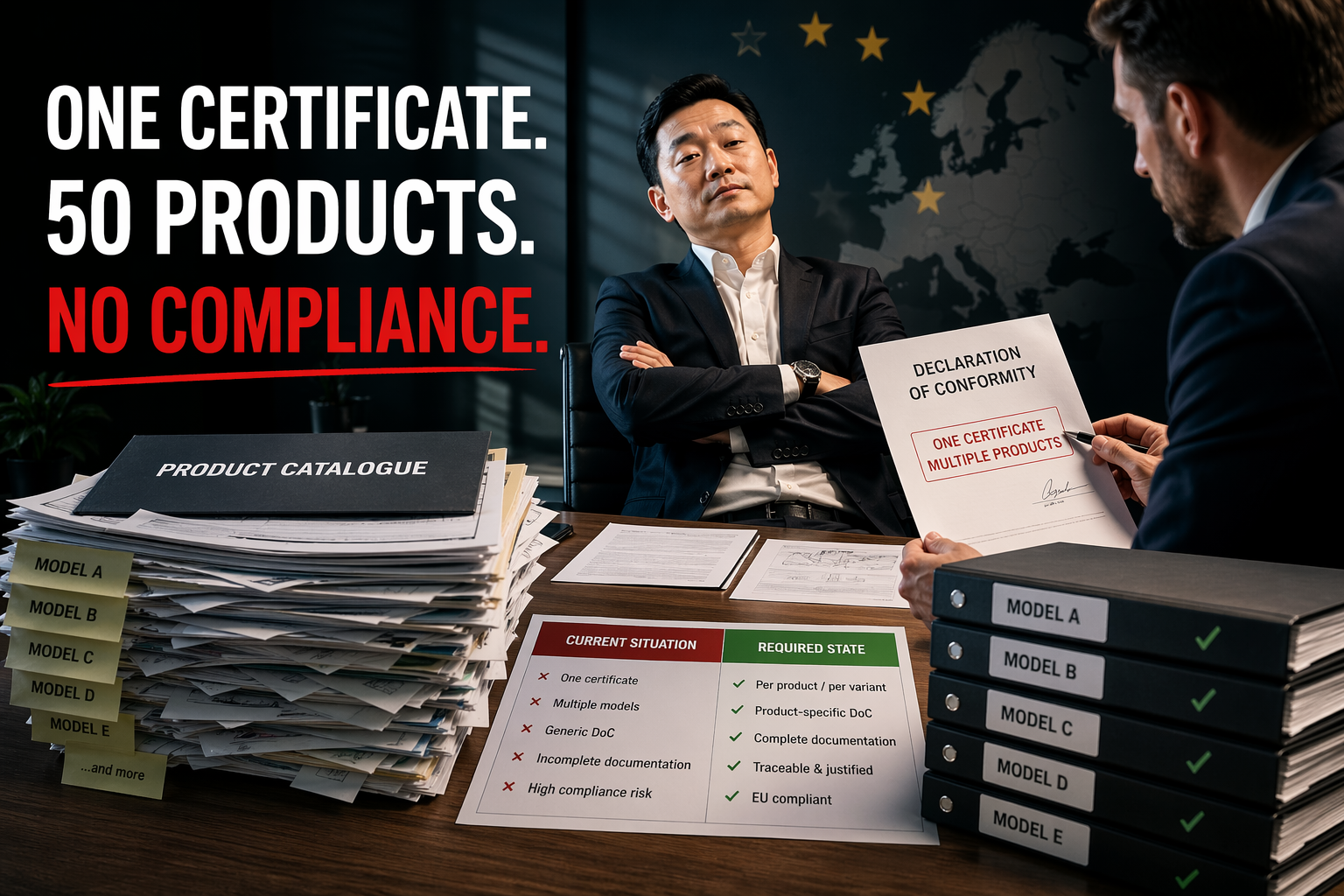
Typical Reality vs. Required Compliance Structure
The gap between perceived and actual compliance becomes most visible when comparing real-world setups with regulatory requirements. What many manufacturers consider sufficient often falls short under scrutiny. The difference is not marginal — it is structural, and it directly determines whether a product can legally remain on the EU market.
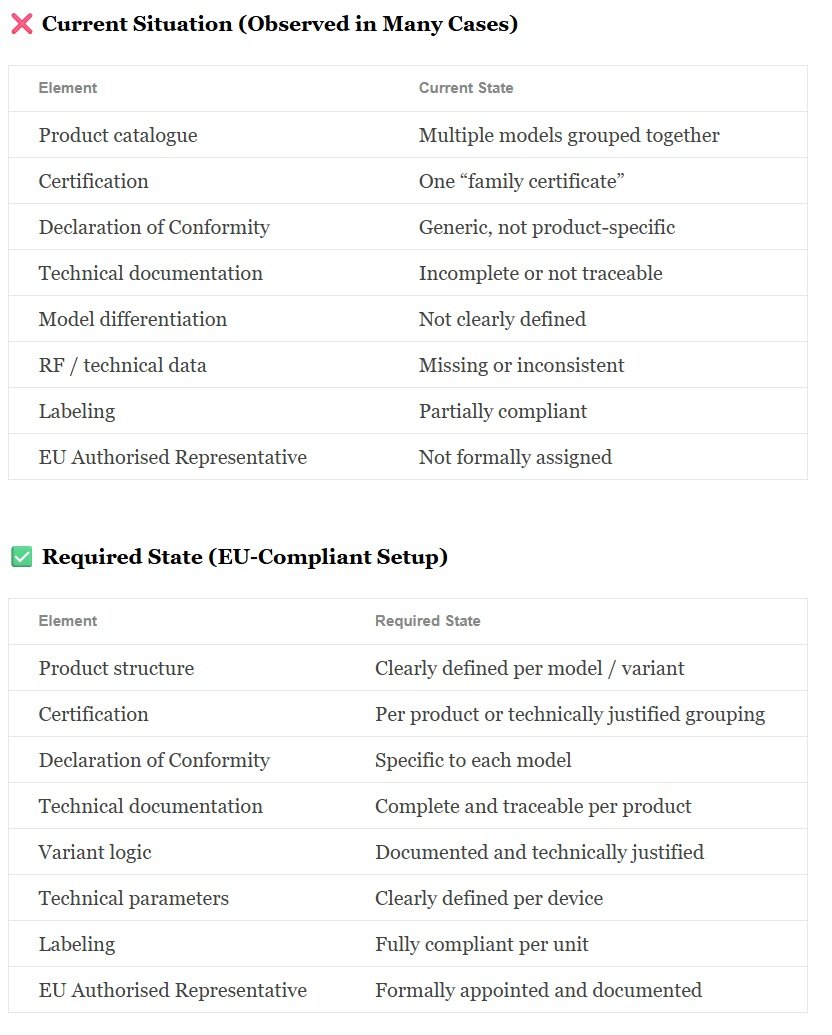
Why “Family Certification” Often Fails
At first glance, grouping products under a single certification appears practical and cost-efficient. However, this approach is only valid under strict technical conditions. Once these conditions are not fully met, the entire certification loses its reliability — turning what seems compliant into a significant regulatory risk.
The idea of grouping products into one certification is not wrong by itself.
However, it only works if:
- The products are technically identical or very closely related
- Differences are clearly documented and justified
- All variants are fully covered by testing and documentation
In many real-world cases, this is not the case.
Instead, we see:
- Different radio modules or frequencies
- Changed components or suppliers
- Variations in power levels or configurations
- Missing linkage between models and test reports
The result: The certificate does not actually cover all products.
The Risk: Enforcement Is Increasing
EU market surveillance is no longer theoretical — it is actively enforced. Authorities are increasingly focused on identifying structural compliance gaps, not just isolated issues. What may start as a single inquiry can quickly escalate into a full review, exposing weaknesses across the entire product portfolio. Authorities across the EU are becoming significantly more active in market surveillance.
Typical consequences of non-compliant structures include:
- Requests for full technical documentation
- Immediate compliance checks across product portfolios
- Sales restrictions or product removals
- Customs delays or stops
- Platform enforcement (e.g. marketplaces removing listings)
And most importantly:
- Authorities do not review “one product”.
- They review your entire catalogue once an issue is identified.
The Core Mistake
At the center of many compliance issues lies a simple but critical misunderstanding. It is not about missing documents or minor gaps — it is about the underlying logic. When compliance is structured incorrectly from the start, even complete documentation cannot ensure that regulatory requirements are actually met.
The fundamental misunderstanding is this:
Manufacturers structure compliance
👉 around certificates
But EU law requires compliance
👉 around products
This leads to a dangerous gap between documentation and reality.
How to Fix It: A Practical Approach
Fixing compliance issues does not require starting from scratch — but it does require a structured approach. The goal is not to add complexity, but to align documentation with how EU regulations actually work. With the right steps, gaps can be identified, corrected, and turned into a robust, defensible compliance setup.
A compliant structure does not necessarily mean more bureaucracy — but it requires the right logic.
Step 1: Define Your Product Structure
- Identify each product and variant clearly
- Define what is technically identical and what is not
Step 2: Map Documentation to Products
- Assign test reports, certificates, and data to each model
- Ensure traceability
Step 3: Validate Certification Scope
- Check whether certificates actually cover all variants
- Close gaps where necessary
Step 4: Create Product-Specific Declarations
- One Declaration of Conformity per product
- Clear and consistent information
Step 5: Ensure Complete Technical Documentation
- Available, structured, and accessible
- Ready for authority requests at any time
Step 6: Establish a Formal EU Setup
- Appoint an EU Authorised Representative where required
- Define communication and responsibility structure
Final Thought
In the end, compliance is not defined by the presence of documents, but by how well they reflect the actual product reality. Simplified structures may seem efficient, but they often fail under scrutiny. What matters is a consistent, product-based approach that holds up when it is truly tested.
- A product catalogue is not a compliance structure.
- A certificate is not a system.
Compliance must follow the product — not the PDF.
If you are unsure whether your setup is compliant:
👉 We offer a structured compliance screening for non-EU manufacturers.
- review of your current setup
- identification of gaps
- clear recommendations
Contact us to assess your EU compliance status before authorities do.
_______
Tätigkeiten, die der Gesetzgeber Rechtsanwälten, Steuerberatern,
Wirtschaftsprüfern und anderen besonderen Berufsgruppen vorbehalten hat,
gehören gemäß unseren Mandatsvereinbarungen ausdrücklich nicht zu unserem
Mandatsumfang. Werden solche Tätigkeiten erforderlich, so vermitteln wir
unserem Mandanten uns bekannte, seriöse Beratungskollegen aus den
zugelassenen Berufsgruppen.
Unsere Tätigkeit erstreckt sich ausschließlich auf die Ermittlung von
wirtschaftlichen Sachverhalten im Rahmen unseres unternehmens- und
wirtschaftsberatenden Mandates sowie die Vor- und Aufbereitung der aus der
Ermittlung dieser wirtschaftlichen Sachverhalte resultierenden
Entscheidungen und Unterlagen.
Unsere Ratgeber weisen Ihnen den Weg bei beruflichen Problemen. Daher haben
praxisrelevante Fälle für Sie herausgesucht und exemplarisch beantwortet –
ohne Anspruch auf inhaltliche Vollständigkeit. Bitte bedenken Sie, dass
nicht alle denkbaren Besonderheiten des Einzelfalls berücksichtigt sein
können. Die Lektüre des Ratgebers ersetzt keine individuelle Beratung.

_______
Als Werbe-Partner verdienen wir an qualifizierten Käufen von Affiliate-Programmen ( siehe unsere Datenschutzbestimmungen ). Für Sie verändert sich der Preis nicht.
- Auxmoney – 50.000 € Kredite für Selbständige
- SCHUFA-neutraler Kreditvergleich für Selbständige
- AGB-Sicherheitspakete für Online-Händler
- Gasanbieter wechseln – bis zu 750 € sparen
- Stromanbieter wechseln – bis zu 440 € sparen
- Private Krankenversicherung – offizieller Tarifrechner
- Kfz-Versicherung – bis zu 850 € sparen
- Haftpflichtversicherung – bis zu 70 % sparen
- Hausratversicherung – TÜV „sehr gut“
- Rechtsschutzversicherung online berechnen
- DSL-Verfügbarkeitscheck
- Pauschalreisen günstig buchen
- Mietwagen-Preisvergleich